
“Restrictions breed creativity.”
-Mark Rosewater, notable for his career as an escape artist
Be Funny. Make People Laugh.
It’s the comedian’s singular imperative, an impossibly large command.
It seems simple – Just be funny! That’s all that’s asked of you. Of course, it’s actually quite complicated. Jerry Seinfeld wouldn’t be a gorillionaire if it wasn’t. Recognizing funny is simple; babies recognize funny. Peek-a-boo? Comedy gold.
Creation, obviously, is trickier. Finding that which is funny is a matter of finding what Funny is.
What Funny is, then, is left as an exercise for the reader. It’s an exercise that most people engage in daily. Every time you write a joke, quote a movie, cast a pod, tik a tok, or imitate your coworker with the wonky laugh behind their back, you are taking a measure of the heart of comedy. Consciously or not, you are exploring the bounds of where Funny is or isn’t.
Whether or not that’s a needlessly faffy way of saying something fairly plain, it remains true that this is a difficult (and fruitful!) endeavor. It takes a lot of effort, practice, and experience to become familiar with where Funny tends to be.
So where to start? Counterintuitively, being presented with complete freedom to write in any direction can be stifling. A blank page suggests everything, equally and all at once; and so suggests nothing at all.

However, apply a few arbitrary restrictions –

– and the mind leaps with possibilities.
Here’s the pitch; Creative Limitations. The utility of applying limitations to your creative process is two-fold. Firstly, it gives you a starting place for who you want to be on stage. Secondly, it can help you write outside the box, and go places you’d normally overlook.
In practice, what does this look like? Having gone to a few open mics and watched others perform, I knew pretty quickly that there were things I didn’t want to do on stage. I wrote them down, and then when I was reasonably happy with my commandments, I chiseled them into a stone tablet that I had lying around.
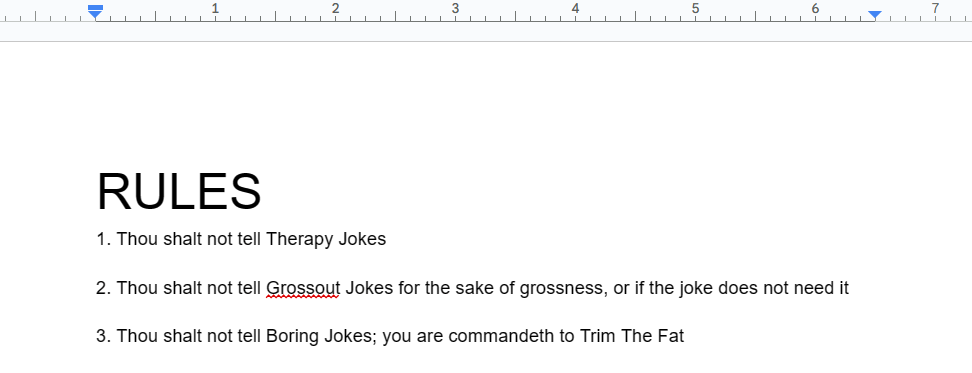
Rule 1 is pretty straightforward; don’t tell jokes that are actually just things you should say to your therapist. I understand the temptation to talk about personal problems to a captive audience. You should talk about your personal stuff with a close friend, not with a room full of drunk strangers. And remember, a lot of the things you’re embarrassed or ashamed of seem a lot bigger to you than they actually are. Just because you think people will laugh at you, doesn’t mean they will.
Rule 2 is poorly named. My bad. In my head, “Grossout” doesn’t necessarily mean a joke that involves a shart. It’s more of an umbrella (unrelated to the shart) term for jokes that are abusive or trivialize sensitive subjects. I’m not against touching on heavy, unpleasant, or gross topics, but I’m against making dead babies the butt of a joke.
Rule 3 doesn’t need much explanation. Even if there’s just one person in the audience, I want to respect the time that’s been afforded to me. An added benefit is that this rule also pushes me to write more material, and connect material I might not have connected otherwise.
Side note: To reiterate, these are my personal rules. If they help you, great! But everyone’s goals are different.
Besides as a general guidestone, creative limitations can also be helpful on a smaller scale, while writing. Absent limitation, people tend to solve problems in ways they’ve solved problems before. This is very efficient for regular tasks, but runs contrary to our goal of producing novel ideas. By setting out what we can’t use at the start, we force ourselves to work in unfamiliar territory and produce potentially new ideas.
Of course, just because we found a new idea doesn’t mean we’ve found something funny. Here again, limitations can be useful in refining ideas. By knowing what the joke at the heart of the idea isn’t, we can shave down time spent trying to find what the joke is. Practice is iterative. If you want to write good jokes, you have to write a lot of bad ones, and streamlining your writing process will get you to the good jokes faster.
Finally, working backwards by process of elimination can bring you to peculiar or interesting ideas that you might not have come by otherwise. Sort of like lateral thinking.
“When you have eliminated the impossible, whatever remains, no matter how fucking dumb, might be kind of funny.”
– Sherlock “Pete” Holmes
Of course, some limitations end up being more useful than others, although even the bad ones can yield valuable insight.
What if I told all my jokes as if they were impressions?
What if I wrote a set, and the entire thing was a just Shark Tank pitch?
What if I had to write a set without any punchlines? (Complete disaster, don’t do this.)
TL;DR
Creative Limitation is a way of structuring your process. It isn’t about closing yourself off to possibility. It’s about shifting your perspective and aligning your character on stage. Limitation can also help induce creative thinking, refine joke ideas, make your dick bigger, do your meemaw’s grocery shopping, and tuck you into bed at night.
If you’ve made it this far, tell us what you don’t think! 🙂
 Never Had It, Never Will